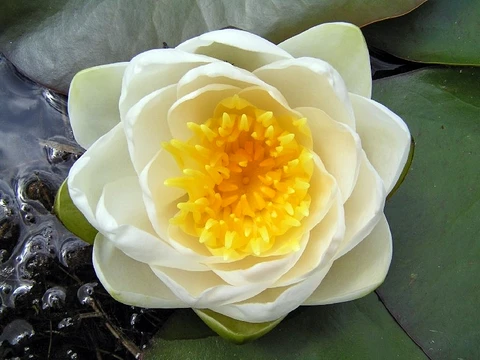
Nymphaeaceae
Basal aquatic flowering plants with diverse pollination strategies.

Nymphaeaceae is a family of flowering plants commonly known as water lilies. They are rhizomatous aquatic herbs found in temperate and tropical climates worldwide, comprising five genera and about 70 known species. Water lilies are rooted in soil in bodies of water, with leaves and flowers floating on or rising from the surface. The family has been extensively studied because its large flowers with multiple unspecialized parts were initially thought to represent the floral pattern of the earliest flowering plants; later genetic studies confirmed their position as basal angiosperms.
- Common name
- Water lilies
- Number of genera
- 3 to 6 (Barclaya, Euryale, Nuphar, Nymphaea, Ondinea, Victoria)
- Number of species
- About 70
- Habitat
- Aquatic, rhizomatous herbs in temperate and tropical climates
- Key characteristic
- Basal angiosperms; flowers with multiple unspecialized parts
- Pollination syndromes
- Beetle, fly, bee, self-, or wind-pollination
Lore & Background
The Nymphaeaceae are annual or perennial aquatic herbs with scattered vascular bundles and frequent latex. Leaves are alternate, spiral, opposite, or whorled, simple, peltate or nearly so, with palmate to pinnate venation. Flowers are solitary, bisexual, radial, with 4–12 sepals, petals lacking or 8 to numerous, stamens 3 to numerous, and carpels 3 to numerous. The fruit is an aggregate of nuts, a berry, or an irregularly dehiscent capsule. Seeds are often arillate and lack endosperm. Genetic analyses by the Angiosperm Phylogeny Group have confirmed Nymphaeaceae's basal position among flowering plants, placing it in the order Nymphaeales, the second diverging group after Amborella in the APG IV system. The family is more genetically diverse and geographically dispersed than other basal angiosperms. Genera with more floral parts (Nuphar, Nymphaea, Victoria) have beetle pollination, while those with fewer parts are pollinated by flies, bees, or are self- or wind-pollinated, indicating that the large number of floral organs is not ancestral. Fossil species include Cretaceous representatives of Nymphaea and genera such as Jaguariba, Allenbya, Notonuphar, Nuphaea, Susiea, and Barclayopsis. The sacred lotus was once considered a water lily but is now placed in Nelumbonaceae.
Reader's Guide
Nymphaeaceae holds significant evolutionary importance as a basal angiosperm family, providing insights into early flower structure and pollination evolution. Its large, unspecialized flowers were long considered ancestral, but modern analyses show that genera with more floral parts are derived and associated with beetle pollination, while those with fewer parts use other strategies. This challenges earlier assumptions about floral evolution. The family's widespread use as ornamentals has led to invasiveness in some regions, such as the Mexican waterlily in California. Culturally, water lilies are national symbols of Bangladesh, Iran, and Sri Lanka, appear in ancient Persian reliefs, and feature in heraldry (e.g., flag of Friesland). They were also important in Maya civilization as indicators of clean water and possibly used entheogenically. Claude Monet famously depicted them in a series of paintings. The family's fossil record extends to the Cretaceous, underscoring its long evolutionary history.
Did You Know?
- The family contains five genera with about 70 known species.
- Genera with more floral parts (Nuphar, Nymphaea, Victoria) have beetle pollination syndromes.
- The sacred lotus was once thought to be a water lily but is now recognized as a eudicot in Nelumbonaceae.
- Water lilies were used by the Maya as a visual sign of water cleanliness and possibly as entheogens.
Evolutionary Position and the Puzzle of Floral Complexity
Water lilies have long occupied a special place in botanical thought. Their large blooms, packed with numerous unspecialized floral organs, led early researchers to believe these flowers captured the original blueprint of all flowering plants. Decades of systematic study followed this assumption, making Nymphaeaceae one of the most thoroughly investigated plant families. Modern genetic work by the Angiosperm Phylogeny Group has confirmed that water lilies do sit at the base of the angiosperm tree, branching off second only to Amborella in the APG IV framework. Yet the story is more nuanced than the 'most primitive flower' label suggests. Comparisons with the sister family Cabombaceae reveal that genera bearing the greatest number of floral parts—Nuphar, Nymphaea, and Victoria—are actually more evolutionarily derived than their relatives with fewer parts. The abundance of sepals, petals, and stamens is therefore not an ancestral trait but a later specialization tied to beetle pollination, while genera with simpler flowers rely on flies, bees, wind, or self-fertilization.
Morphological Range and Reproductive Strategies
Within just five to six genera and roughly seventy species, water lilies display a striking variety of form. Leaves range from the oval, heart-shaped blades of Barclaya to the fully circular pads of Victoria and Euryale, while Nymphaea and Nuphar produce round leaves split by a radial notch. All are rooted in submerged soil, their petioles holding foliage either flat on the water, slightly above it, or fully emergent. Flowers are solitary, radially symmetrical, and typically bisexual, perched on long stalks that lift them to or above the surface. Sepal counts run from four to twelve, petals from eight to many, and stamens and carpels from three to numerous. Reproduction is flexible: many species are protogynous, with female parts maturing before male ones, yet the overlap on the second day of flowering and self-compatibility allow self-fertilization as a backup. Beetle pollination dominates in the more florally complex genera, while simpler-flowered relatives enlist flies, bees, or the wind. Fruits vary from nut aggregates to berries to spongy, irregularly splitting capsules, and seeds often carry an aril but little endosperm.
Taxonomic Revisions and a Deep Fossil Record
The boundaries of Nymphaeaceae have shifted repeatedly as evidence accumulated. Barclaya, once elevated to its own family Barclayaceae because of its extended perianth tube and basally joined stamens, is now retained within the family on the strength of molecular phylogenetics. Ondinea, long treated as a separate genus, has been reclassified as a morphologically unusual species of Nymphaea. Meanwhile, Euryale of far-eastern Asia and Victoria of South America turn out to be close relatives despite their vast geographic separation, though their exact relationship to Nymphaea remains under investigation. The family's deep history is visible in the fossil record: Cretaceous Nymphaea specimens, the Brazilian genus Jaguariba, Allenbya from the Ypresian of British Columbia, Notonuphar from Eocene Antarctica, Nuphaea from Eocene Germany, Susiea from the Late Paleocene of North Dakota, and Barclayopsis from the Maastrichtian of Eisleben. Together these fossils trace a lineage spanning over a hundred million years and multiple continents. The sacred lotus, once lumped in with water lilies, is now recognized as a highly modified eudicot belonging to the separate family Nelumbonaceae.
Cultural Resonance and Ecological Consequences
Water lilies carry deep symbolic weight across multiple civilizations. They serve as the national flower of Bangladesh, Iran, and Sri Lanka; the emblem of Bangladesh depicts a lily floating on water, and the plant is also the designated birth flower for July. The lotus motif was woven into Kaveh the blacksmith's Derafsh banner and later became the flag of the Sasanian Empire, the Derafsh Kaviani. Today it anchors the symbol of Iran's Solar Hijri Calendar. In Northern European heraldry, lily pads—called Seeblätter—appear as charges, often rendered in red, and feature on the flag of Friesland. Beyond culture, the family's beauty has driven widespread ornamental planting, with consequences. The Mexican waterlily, native to the Gulf Coast, has escaped cultivation in places like California's San Joaquin Valley, infesting slow-moving waters and proving difficult to eradicate. Management relies on cutting top growth or applying herbicides such as glyphosate and fluridone.
More in Aquatic & Wetland Plants 1-17
Spotted an error? Know more?
This is a living reference — every entry is fact-audited, and reader corrections feed straight into our audit queue. Suggest an edit · See this site's audit record