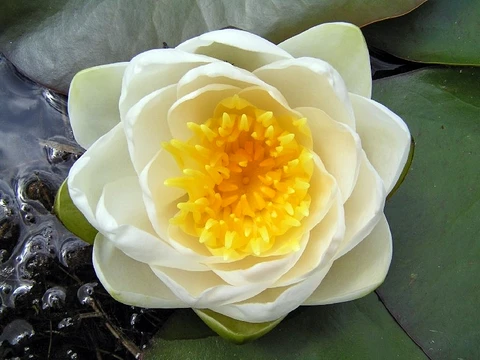
Nymphaea lotus
A rhizomatous aquatic herb, type species of its subgenus.

Nymphaea lotus, commonly known as the white Egyptian lotus, tiger lotus, white lotus, or Egyptian water-lily, is a flowering plant in the family Nymphaeaceae. Lotos.
- Chromosome count
- 2n = 84 (or 80–84)
- Conservation status
- Least Concern (LC) globally
Lore & Background
The Egyptian lotus is the national flower of Egypt and was included by Claire Waight Keller to represent Malawi in Meghan Markle's wedding veil. The tubers and seeds are used as food, and the plant is cultivated as an ornamental in aquaria under bright conditions in warm water. Its chemistry includes compounds such as myricitrin, nympholide A and B, and penta-O-galloyl-β-D-glucose.
Reader's Guide
Nymphaea lotus holds significance as both a cultural symbol and a botanical subject. As the national flower of Egypt, it represents a long historical association with the region, and its inclusion in Meghan Markle's wedding veil highlights its role as a symbol for Malawi within the Commonwealth. Botanically, it is notable as the type species of the subgenus Nymphaea subg. The species demonstrates ecological resilience, surviving dry seasons via rhizomes and reducing evaporation, which may inform studies of aquatic plant adaptation. Its conservation status varies: while globally it is of Least Concern, it is Critically Endangered in the Mediterranean, indicating regional threats. The plant's chemistry, including myricitrin and macrocyclic derivatives, contributes to its potential pharmacological interest. Additionally, its use as food and as an aquarium ornamental underscores its practical value. The taxonomic clarification of Nymphaea lotus var. thermalis through DNA analysis resolves a long-standing question about relic populations, showing that the variety is not genetically distinct. Overall, Nymphaea lotus bridges cultural heritage, ecological function, and scientific inquiry.
Did You Know?
- Nymphaea lotus is the type species of the subgenus Nymphaea subg. Lotos.
- Its flowers are nocturnal and protogynous, with 19–20 petals and 40–80 yellow stamens.
- The plant can reduce evaporation by up to 18 percent during summer.
- DNA analysis shows that Nymphaea lotus var. thermalis is genetically distinct and considered a relict population.
Morphology and Growth Form
Water lilies are aquatic perennials or annuals that anchor themselves through rhizomatous or tuberous root systems, sometimes producing stolons. Their contractile roots may be tuberous or fibrous in structure. The most recognisable feature is the floating leaf, though submerged and emergent forms also occur. Lamina shapes vary widely—ovate, orbicular, elliptic, hastate, or sagittate—spanning from a mere 2.5–3 cm to as large as 40–60 cm across. Each blade bears a deep sinus with basal lobes that may overlap or diverge, and margins can be entire, dentate, or sinuate. Petioles stretch from a few centimetres to an impressive 5–6 m in length. The flowers, whether emergent, floating, or rarely submerged, display 3 to 5 green sepals and 6 to 50 lanceolate to spathulate petals in varied hues, often blending gradually into stamen-like shapes. Fruits are globose, fleshy, and spongy, releasing arillate seeds that may be hairy or smooth.
Taxonomic Complexity and Evolutionary Position
The genus is divided into six subgenera—Anecphya, Brachyceras, Confluentes, Hydrocallis, Lotos, and the autonym Nymphaea—with the latter further split into three sections: Chamaenymphaea, Nymphaea, and Xanthantha. brongniartii and N. elisabethae. Notably, several studies suggest Nymphaea may be paraphyletic, as the genera Euryale and Victoria have been nested within it, hinting at unresolved evolutionary relationships. The name itself derives from the Greek νυμφαία, evoking the water nymphs of classical mythology.
Ecological Interactions and Invasive Potential
Nymphaea thrives in both freshwater and brackish water habitats, where it plays a significant ecological role. Pollination strategies vary by subgenus: Hydrocallis relies on Cyclocephala beetles, Lotos is visited by Ruteloryctes morio from the same Cyclocephalini tribe, while Anecphya and Brachyceras attract bees and flies. The autonymous subgenus Nymphaea enjoys the broadest pollinator range, drawing bees, flies, and beetles alike. Many bird species feed on the genus's seeds and fruits, linking it into broader aquatic food webs. However, outside its native range, Nymphaea mexicana and its hybrids have become problematic invasive weeds. In South Africa, the weevil Bagous longulus has been proposed as a biological control agent. A subtler threat comes from naturalised horticultural hybrids, which can displace native species and mask their decline through introgressive hybridisation, making it difficult to distinguish wild populations from escaped cultivars.
Cultivation, Utility, and Conservation Status
Water lilies serve as popular ornamentals in ponds and lakes, where their broad foliage provides shade that suppresses algal growth. Several species, including Nymphaea lotus, are kept in aquariums. The horticultural world has produced numerous hybrids and cultivars, several of which have earned the Royal Horticultural Society's Award of Garden Merit—'Escarboucle' with its orange-red blooms, 'Gladstoniana' with double white flowers and prominent yellow stamens, 'Gonnère' with scented double white petals, 'James Brydon' in cupped rose-red, 'Marliacea Chromatella' in pale yellow, and the miniature 'Pygmaea Helvola' with fragrant yellow cups. Despite their beauty, all water lilies contain the alkaloid nupharin, rendering them poisonous. Yet in India they have been consumed as famine food or cooked for medicinal purposes, and in Sri Lanka they were historically valued as a costly medicine. Conservation remains urgent: Nymphaea thermarum is critically endangered, while N. loriana, N. stuhlmannii, and N. nouchali var. mutandaensis are all classified as endangered.
More in Aquatic & Wetland Plants 1-17
Spotted an error? Know more?
This is a living reference — every entry is fact-audited, and reader corrections feed straight into our audit queue. Suggest an edit · See this site's audit record