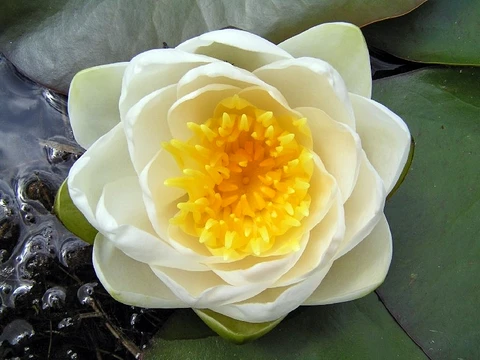
Nymphaea thermarum
Tiny Rwandan water lily saved from extinction by seed propagation.

Nymphaea thermarum, also known as the Miniature Rwandan water lily, is a species of water lily endemic to Rwanda.
- field
- Botany
- known_for
- Smallest water lily; saved from extinction by cultivation at Kew
- native_habitat
- Damp mud from a freshwater hot spring in Mashyuza, southwest Rwanda
Lore & Background
Its native habitat was a small area of damp mud formed by overflow from a freshwater hot spring. Before extinction, Fischer sent specimens to Bonn Botanic Gardens, but botanists could not propagate them from seed. The first successful germination was achieved by Carlos Magdalena at the Royal Botanic Gardens, Kew. During this time, a rat ate one of the last two cultivated plants in Germany. Botanic gardens have been criticized for not providing plant material to repatriate to Rwanda.
Reader's Guide
Nymphaea thermarum is significant as a diminutive aquatic species that was saved from extinction through ex situ cultivation at the Royal Botanic Gardens, Kew. Its small size, rapid lifecycle, and small genome have led to proposals for its use as a model species for basal angiosperms, including studies of seed evolution. Its diploid chromosome count is 2n = 28, and its chloroplast genome is identical to that of Nymphaea heudelotii. The species' cultivation potential as a houseplant has been noted, though repatriation efforts have faced criticism.
Did You Know?
- The specific epithet 'thermarum' refers to the hot spring habitat of the species.
- A rat ate one of the last two cultivated plants in Germany during the conservation effort.
- The chloroplast genomes of Nymphaea thermarum and Nymphaea heudelotii are identical.
Taxonomic Identity & Nomenclature
thermarum is one among them. The genus name itself draws on the Greek νυμφαία and Latin nymphaea, both translating to "water lily" and echoing the water nymphs of classical mythology. Taxonomically, the genus is organised into six subgenera—Anecphya, Brachyceras, Confluentes, Hydrocallis, Lotos, and the autonymous Nymphaea—with the latter further divided into three sections. Three historical synonyms (Castalia, Leuconymphaea, and Ondinea) reflect earlier attempts to split the group. Notably, several phylogenetic studies have suggested the genus as currently circumscribed may be paraphyletic, with Euryale and Victoria potentially belonging within it. The type species remains Nymphaea alba, anchoring the nomenclature that N. thermarum shares.
Morphological Character & Cytology
As a member of the genus Nymphaea, N. thermarum shares the fundamental architecture of water lilies: an aquatic, rhizomatous or tuberous perennial or occasionally annual herb. Its leaves are predominantly floating on the water surface, though submerged and emergent forms also occur within the genus. The leaf blade takes shapes ranging from ovate and orbicular to elliptic, hastate, or sagittate, with a deep basal sinus and lobes that may overlap or diverge. Lamina width spans an extraordinary range across the genus, from roughly 2.5 to 3 cm up to 40 to 60 cm, while petioles stretch from a few centimetres to as much as 5 to 6 metres.
Conservation Status & Hybridisation Threats
Nymphaea thermarum carries the critically endangered classification, placing it in the most immediate danger category for plant species. It is not alone in this precarious position: Nymphaea loriana, N. stuhlmannii, and N. nouchali var. mutandaensis all hold endangered status, underscoring a pattern of vulnerability across the genus. Beyond direct habitat pressures, a subtler threat looms from horticultural practice. Invasive cultivars—particularly Nymphaea mexicana and its hybrids—have established themselves as weeds outside their native ranges, and in South Africa the weevil Bagous longulus has been proposed as a biological control agent. More insidiously, naturalised hybrids can introgress with wild populations, displacing native species and masking their decline because distinguishing a pure species from a hybridised individual is often extremely difficult. For a taxon already at the edge of extinction like N. thermarum, such genetic swamping represents a compounding risk that habitat protection alone may not resolve.
Ecological Role & Cultural Presence
Within the genus's cosmopolitan freshwater and brackish-water habitats, Nymphaea species play layered ecological roles. Pollination is a diverse affair: beetle pollinators such as Cyclocephala and Ruteloryctes morio service certain subgenera, while bees and flies handle others, and the autonymous subgenus Nymphaea draws on all three groups. Birds in turn feed on the seeds and fleshy fruits, linking the plants to broader avian food webs. Yet the genus is not without danger to those who encounter it: all water lilies contain the alkaloid nupharin, rendering virtually every part poisonous. Despite this toxicity, the plants have seen limited culinary and medicinal use in parts of South Asia. Culturally, water lilies remain among the most widely cultivated ornamental aquatics, with numerous hybrids and cultivars earning the Royal Horticultural Society's Award of Garden Merit. The genus's ornamental appeal, however, is the very trait that has driven its spread as an introduced and sometimes weedy presence far from native waters.
More in Aquatic & Wetland Plants 1-17
Spotted an error? Know more?
This is a living reference — every entry is fact-audited, and reader corrections feed straight into our audit queue. Suggest an edit · See this site's audit record