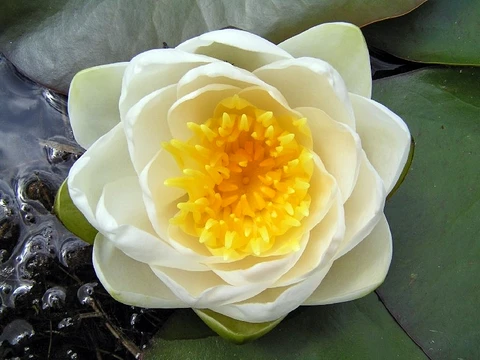
Nymphaea
A cosmopolitan genus of aquatic plants known as water lilies.

Nymphaea is a genus of hardy and tender aquatic plants in the family Nymphaeaceae, commonly known as water lilies. The genus has a cosmopolitan distribution and includes many species cultivated as ornamentals, with numerous cultivars bred for gardens and water features.
- scientific_name
- Nymphaea L.
- family
- Nymphaeaceae
- type_species
- Nymphaea alba L.
- ploidy_range
- 2x to 16x
- pollinators
- bees, flies, beetles, and Cyclocephala beetles
Lore & Background
It has three synonyms: Castalia Salisb., Leuconymphaea Kuntze, and Ondinea Hartog. The genus has been divided into several subgenera, including Nymphaea subg. Anecphya, Brachyceras, Confluentes, Hydrocallis, Lotos, and Nymphaea. The subgenus Nymphaea subg. Nymphaea is further divided into sections: Chamaenymphaea, Nymphaea, and Xanthantha. The genus may be paraphyletic in its current circumscription, as the genera Euryale and Victoria have been placed within Nymphaea in several studies.
Reader's Guide
Water lilies are significant both ecologically and culturally. They provide shade that helps reduce algae growth in ponds and lakes, and some species are kept in aquariums. Many familiar water lilies are hybrids and cultivars, several of which have gained the Royal Horticultural Society's Award of Garden Merit. The Ancient Egyptians used water lilies of the Nile as cultural symbols, associating the lotus motif with creation and fertility. The French Impressionist painter Claude Monet is known for his many paintings of water lilies. However, some species are invasive outside their native range; Nymphaea mexicana and its hybrids have become invasive weeds, and the weevil Bagous longulus has been proposed as a biocontrol agent. Several species face extinction, including Nymphaea thermarum (critically endangered) and Nymphaea loriana (endangered). All water lilies are poisonous, containing the alkaloid nupharin, yet they have been used as food in various cultures, including India, Sri Lanka, West Africa, and North America.
Did You Know?
- The genus name derives from Greek and Latin words for 'water lily,' inspired by nymphs of mythology.
- Nymphaea thermarum is listed as Extinct in the Wild (EW) by the IUCN.
- The flowers can be diurnal or nocturnal, and are mostly protogynous.
- Some species have proliferating pseudoviviparous flowers or tuberous flower buds for vegetative propagation.
Distribution and Habitat
The American white waterlily, a name that captures both its geography and its most striking visual feature, is an aquatic species within the genus Nymphaea. It thrives in calm, shallow bodies of water—lakes, ponds, and slow-moving permanent streams—across a remarkably broad stretch of the continent, stretching from Central America all the way up into northern Canada. Beyond its primary North American range, the species has also been documented in South America, with reports placing it in both Brazil and Guyana. The plant has accumulated a long list of common names over the centuries, including fragrant water-lily, beaver root, sweet-scented white water lily, and simply white water lily, each reflecting a different regional observation or use. Whether encountered in a still pond in the Canadian north or a slow river in Central America, the species presents the same essential ecological niche: a rooted, floating-leaved plant that anchors itself in soft sediment while its foliage and blossoms drift on the water's surface.
Morphology and the Daily Flowering Cycle
Beneath the water's surface, Nymphaea odorata anchors itself through a network of branched rhizomes that spread through the substrate. From these underground structures, long petioles rise to support smooth, floating leaves that rest on the surface. The flowers, which also float, display a radially symmetric arrangement featuring numerous white petals surrounding a cluster of prominent yellow stamens. One of the plant's most distinctive behavioral traits is its daily rhythm: the blossoms open in daylight and close again at night, releasing a strong fragrance while they are open. After successful pollination, the developing fruit is drawn back beneath the water's surface, where it matures in the submerged environment. This transition from above-water flowering to below-water fruit development represents a remarkable adaptation that protects the maturing seeds in a stable aquatic setting. The entire life cycle—from rhizome to leaf to flower to submerged fruit—unfolds in close coordination with the plant's aquatic habitat.
Culinary and Medicinal Uses Across Cultures
Long before modern pharmacology, communities across North America turned to the fragrant water-lily for both sustenance and medicine. The seeds, flowers, and rhizomes are all edible, suitable for consumption either raw or cooked, making the plant a versatile food source. Beyond nutrition, various parts have been employed in folk remedies for generations. Boiling the root yields a liquid that can be gargled to soothe sore throats or ingested to address diarrhea. Native American traditions specifically called upon the rhizomes to ease coughs and colds, while the stem itself was pressed directly against aching teeth to relieve toothache. The plant's utility extends beyond human use as well: muskrats feed on the muck-submerged stems, incorporating them into their diet in wetland ecosystems. This wide array of applications—from edible parts to topical remedies to wildlife forage—speaks to the plant's deep integration into both human cultural practices and the broader food web of its aquatic habitats.
Biochemistry and Taxonomic Subdivision
At the molecular level, Nymphaea odorata harbors a diverse suite of secondary metabolites. Among the lignans identified in the species are nymphaeoside A and icariside E. The flavonol profile is particularly rich, including kaempferol 3-O-alpha-l-rhamnopyranoside (commonly known as afzelin), quercetin 3-O-alpha-l-rhamnopyranoside (quercitrin), and myricetin 3-O-alpha-l-rhamnopyranoside (myricitrin). Additional flavonols present include quercetin 3-O-(6'-O-acetyl)-beta-d-galactopyranoside, myricetin 3-O-beta-d-galactopyranoside, and myricetin 3-O-(6'-O-acetyl)-beta-d-galactopyranoside. Taxonomically, the species is divided into two recognized subspecies: Nymphaea odorata subsp. odorata and Nymphaea odorata subsp. tuberosa, the latter originally described by Paine and later reclassified by Wiersema and Hellquist. This combination of chemical complexity and taxonomic subdivision underscores the biological depth of what appears, at first glance, to be a simple pond flower.
More in Aquatic & Wetland Plants 1-17
Spotted an error? Know more?
This is a living reference — every entry is fact-audited, and reader corrections feed straight into our audit queue. Suggest an edit · See this site's audit record