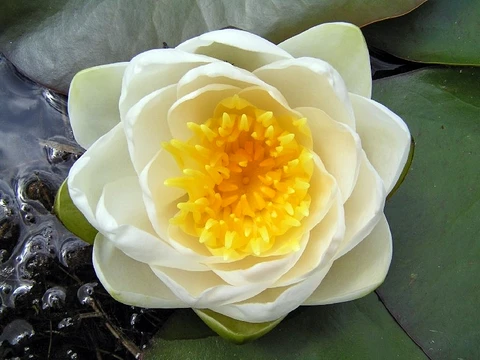
Nymphaea nouchali var. caerulea
Aquatic plant with psychoactive alkaloids, used in ancient Egyptian rituals.

Nymphaea nouchali var. caerulea, also known as Nymphaea caerulea, blue lotus, or blue water lily, is a water lily in the genus Nymphaea, a botanical variety of Nymphaea nouchali. It is an aquatic plant of freshwater lakes, pools, and rivers, naturally found throughout much of sub-Saharan Africa, the Indian subcontinent, and Southeast Asia, and has been spread to other regions as an ornamental plant. It features prominently in Egyptian mythology and art, symbolizing the sun and rebirth, and has been found in pharaohs' tombs.
Lore & Background
Nymphaea nouchali var. caerulea is a perennial aquatic herb with a tuberous rhizome, spreading over about 1 meter. Its peltate leaves are polymorphic, with blades 8–35 cm long, and its flowers, typically pale bluish-white to sky-blue or mauve with a pale yellow center, open mid-morning and close near dusk over four days. The plant contains the psychoactive alkaloid nuciferine and related aporphine alkaloids, which interact with serotonin, dopamine, and adrenergic systems, and has been associated with historical use for aphrodisiac and religious purposes, including in rituals like Hathor's Festival of Drunkenness.
Reader's Guide
Nymphaea nouchali var. caerulea holds significance for its deep roots in Egyptian mythology and art, where it symbolized the sun and rebirth, and for its psychoactive properties attributed to nuciferine and apomorphine. Modern recreational use, through infusions or vaping, has been linked to toxicity, causing sedation and perceptual disturbances. Recent research by UC Berkeley confirmed that authentic Nymphaea caerulea is chemically distinct from many online products, which contain less nuciferine and are misidentified water lilies. Taxonomically, it remains disputed: while often classified as a variety of Nymphaea nouchali, phylogenetic studies have suggested it may be a separate species, Nymphaea caerulea, which is now rare due to habitat loss from the Aswan Dam. Its chemical composition has been studied since the 1970s, with early findings of aporphine alkaloids later confirmed, alongside compounds like 7-hydroxyflavone and methyl vanillate.
Did You Know?
- The plant's flowers contain osmophores that attract bees by deceit, mimicking food without rewarding them.
- The Aswan Dam has been cited as a threat to some local populations of Nymphaea lotus, but Nymphaea nouchali var. caerulea is native to the Nile region in Egypt and may also be affected by such environmental changes.
- Despite occasional claims, no widely recognized 2012 phylogenetic study supports a closer relationship between Nymphaea caerulea and the Mexican endemic Nymphaea gracilis; the plant is generally treated as a variety of N
- The plant's aporphine alkaloid content may explain its historical reputation as an aphrodisiac, as related compounds have been studied for their effects on dopamine systems.
Taxonomic History and the Problem of Classification
The taxonomic identity of this water lily has been a source of persistent confusion among botanists. caerulea, N. ovalifolia, N. colorata, and N. petersiana—into N. nouchali as new varieties. Two additional varieties, var. mutandaensis and var. However, this sweeping circumscription has drawn sharp criticism as highly unnatural, particularly because N. petersiana was later revealed to belong to the subgenus Lotos, making it entirely unrelated to the true N. nouchali, which sits within subgenus Brachyceras. Earlier still, the name N. nouchali was erroneously applied to Nymphaea pubescens, compounding the taxonomic muddle. The blue-flowered variant, N. nouchali var. caerulea, is generally treated as part of this species complex and is widely recognised as the so-called blue Egyptian lotus.
Cultural and Symbolic Heritage Across Civilisations
Few aquatic plants carry as much cultural weight as this water lily across South and Southeast Asia. It holds the distinction of being the national flower of both Bangladesh and Sri Lanka, where it is affectionately called nil mānel or nil mahanel. Ancient Sanskrit, Pali, and Sinhala poets referenced the flower under names such as kuvalaya, kumuda, indhīwara, niluppala, nilōtpaḷa, and nilupul, consistently linking it to ideals of virtue, discipline, and purity. The plant's reach extends even into Western literary imagination, as it may have been the very species consumed by the Lotus-Eaters in Homer's Odyssey. For centuries, Thai and Myanmar gardeners have also prized it for adorning ornamental ponds.
Culinary and Medicinal Uses Across Regions
Despite its ornamental beauty, this water lily has long served as a practical resource across Asia and beyond, though it demands caution. Like all water lilies, its pear-shaped rhizomes, leaves, and most tissues contain the alkaloid nupharin, rendering them poisonous if consumed raw. Unlike European relatives, however, the toxin in this species can be safely neutralised through boiling. In India, the tubers have been eaten as a famine food and in Ayurvedic practice the plant, known as ambal, is prescribed primarily for indigestion. In Vietnam, people roast the tubers; in West Africa, the dry-season rhizomes—nearly pure starch—are boiled or roasted. Sri Lankan villagers once used the plant medicinally at a price too steep for daily meals, but in the 1940s farmers began cultivating it in paddy fields left fallow during the monsoon, driving costs down so it entered curries and boiled dishes. In Bangladesh, the stems, called shapla, are a staple rural vegetable, stir-fried with mustard seeds, spices, and sometimes dried fish in a dish known as shaplar data. Dried plant material is also collected in India during the dry season for use as animal forage.
Botanical Characteristics and Ecological Relationships
Nymphaea nouchali var. caerulea is a day-blooming, non-viviparous aquatic plant with submerged roots and stems. Its round, green leaves—darker on the underside—feature undulating, crenellated margins and measure roughly 20 to 23 centimetres across, with individual pads spreading up to 1.5 metres from the central rhizome. The flower, typically white or blue but occurring in violet, purple, pink, and cream hues, displays four or five sepals and 13 to 15 angular petals that give the bloom a distinctly star-shaped profile when viewed from above. The cup-like calyx ranges from 4 to 15 centimetres in diameter. In the wild, it inhabits static or slow-moving waters of low to moderate depth across a vast range stretching from Afghanistan through the Indian subcontinent, Taiwan, Southeast Asia, and into Australia. Ecologically, its foliage is susceptible to the water-borne fungus Doassansiopsis nymphaea. In Chad, it naturally hybridises with Nymphaea micrantha to produce Nymphaea × daubenyana. In the aquarium trade, it is popularly marketed as the dwarf lily or dwarf red lily.
More in Aquatic & Wetland Plants 1-17
Spotted an error? Know more?
This is a living reference — every entry is fact-audited, and reader corrections feed straight into our audit queue. Suggest an edit · See this site's audit record